Podcast Episode 001
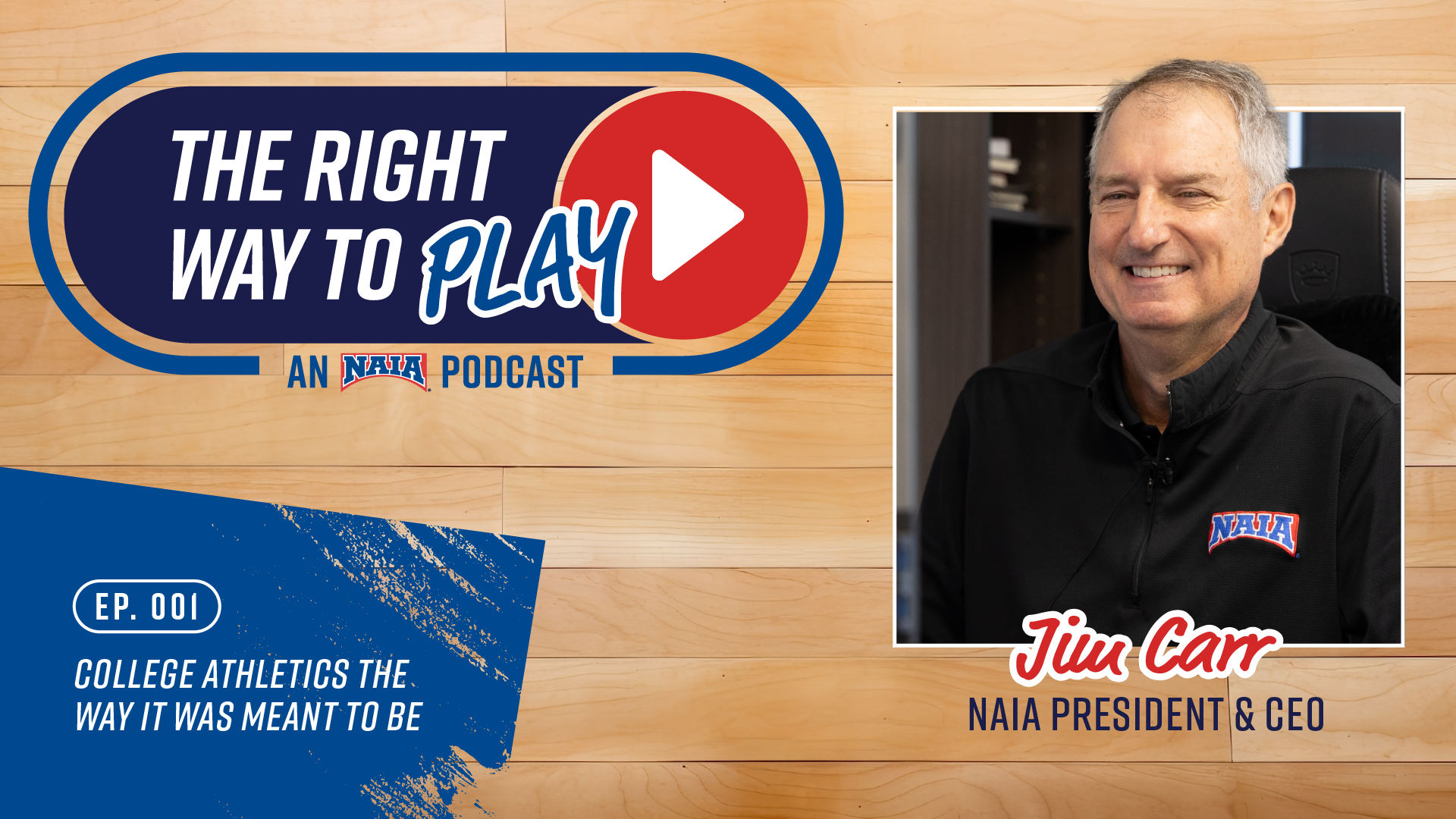
College Athletics The Way it Was Meant to Be
NAIA President & CEO Jim Carr shares how putting student-athletes first, fueling true competition, and keeping integrity at the heart of the game make athletics an engine for growth and long-term sustainability.
Austin Bennett: Welcome to the very first episode of The Right Way to Play, the NAIA podcast, where we go beyond the scoreboard to explore college athletics the way it was meant to be. Each episode, we sit down with coaches, athletic directors, student-athletes, and thought leaders to talk about building champions on and off the field, fostering community through competition and leading with common sense. Whether you're at an NAIA member institution or just passionate about the future of college sports, you'll find inspiration and insights here. Let's dive in.
Alan Grosbach: Austin, I don't know about you, but I'm incredibly excited. We get to talk small college athletics, we get to talk why it matters, and we get to talk about the right way to play. And I personally can't think of a better guest to kick us off this. He's number one on the org chart. He's number one in our hearts. It's NAIA president and CEO, Jim. For those that don't know Jim, he's been with the association since 1998. He started as our managing director and general counsel, eventually evolved into our COO. He took over the CEO and president position in 2006 and has been in that role ever since. A little background on Jim. He's got a bachelor's from Millsaps College, which is a small school in Mississippi. He's got a MS in sports management from UMass and he has his JD from Duke University. He also serves on multiple boards and things, both in the Kansas City area nationally, USA basketball, NAIA Champions of Character Foundation. And really his leadership has been instrumental to the growth of the NAIA over the last...really since his time as becoming president CEO. So Jim, welcome. We're excited to have you and we're excited to talk to you a little bit.
Jim Carr: Yeah, great to be here. Always fun to hang out with you guys.
Austin Bennett: Welcome, Jim. Absolutely. Well, Jim, let's jump right in. So the NAIA's roots go back to 1937, long before today's collegiate sports landscape. You've been with the NAIA since 1998. Just talk to us a little bit about how things have changed in your time with the association.
Jim Carr: Yeah, first Austin, thanks for making it clear. I haven't been here since 1937. I think some people think that might, that might be the case, but, but yeah, since 1998, it's even hard to believe I've been, been here that long, 27 years, been a, been a great ride and a lot of things have changed. Some things have ever remained the same, but the first thing that comes to mind is I think most people have only been around since Champions of Character was in place and really became the kind of the calling card and what I refer to as the compass of the NAIA. It's our kind of true north and what we strive to be at the institutional level, but also at the national level. So that really has changed and impacted the organization. I shouldn't say it's changed because I think the NAIA has always believed in those kinds of tenants and our coaches are still in character and student-athletes from the start. But that program really put it out in front. And so, I think that's been one real important change since 1998 and something we've been consistent with over the last 25 years or so. I also think about the eligibility center. When I started back in 1998, eligibility all ran through the higher institutions and while people did a good job with that, now the eligibility center provides a consistent determination for eligibility for all institutions, all student-athletes. And it's also been a great way for us to get the word out about the NAIA and how it's a good opportunity for student-athletes that some people may not know about or at least without the reach of the eligibility center and the marketing that goes around that. I just wouldn't know that it's available. We certainly have grown in terms of our staff. I mean, Alan and I were talking earlier about half of my time at NAIA. You guys have been here for about 13 years or so. And just the strength of our staff, the expertise, the knowledge, the dedication to our members, I think right now is at an all-time high. We certainly had great staff members over the years. with the resources we've been able to generate through new initiatives like InCred and other things, partnerships that we've brought in. We have so much at our disposal now in order to be able to support our members. So, member value, member support, I think is an all-time high as well. So, a few of the things that just come to mind while there, our competition has always been great and Austin, you've done a great job on the championships front to elevate that. So, things like competition while remaining the same, I think has been elevated, but a of new things, but also just our coaches remaining pivotal to growing people of character through athletics is something that has not wavered in my 27 years and I think is much the same but something to celebrate as well.
Austin Bennett: Absolutely. And when we talk about Champions of Character 25th Anniversary, huge opportunity there for us to continue to keep changing lives on and off the field. When we talk about NAIA athletics, we talk about education-based athletics. How have those things changed? Or what does that mean for student-athletes in today's day and age?
Jim Carr: Yeah, when I think about education-based athletics, I kind of think about it in two different, but complimentary ways. The first this climate today, especially with all the things going on at division one, certainly lots of great exciting athletics happening at division one, but also a very different model these days where it's hard to think about, at least at the very highest levels, that it's not a professional model, at least when it comes to football and basketball. And so, for the NAIA, what we need to be concentrating on these days and making sure we don't lose is the fact that for NAIA student-athletes, athletics has to be embedded within the educational model, within the higher ed model. So, you should not be playing NAIA athletics unless you're at the institution to get an education first and with the goal of graduating or certainly moving through the system in a way that leads to a degree. And so, I know all of our member institutions are committed to that. Our presidents who I work with a lot certainly talk a lot about that and so as an association we need to make sure that we can continue to enforce those rules that require progress towards a degree, require students to be full-time students and make sure that that is set in stone and unwavering. But the second thing I think about with education-based athletics is really as you said Austin, what does it mean to the student-athlete and I think most of our coaches or maybe all of them would agree and I know we believe this as a staff that there's so many opportunities to learn through athletics that either aren't available in the classroom or at least complement what's being taught in the classroom in a great way. It's just a great platform for real life experiences, a chance for student-athletes to succeed and fail in a way that may feel like the best or the worst thing to them at the time, but it's really kind of a no risk type situation. If you fail and you lose a game, you can get back up and play the next day. So, it teaches you how to take those things from competition and apply it to life where it really means something in terms of how you're positioning yourself to become an adult after college and be a great father or mother, a great friend, a great community leader. All those things are taught through athletics in a real way that maybe is available in some ways in the classroom, but in many ways not.
Austin Bennett: When I think what a lot of institutions have found is it really creates that loyalty from the alumni group to, okay, I went through it not only on the field, on the court, whatever, but I went through it in the classroom, in the community, things like that. And actually, have that passion and loyalty back to that institution, which you really, you see it still a little bit, but I think that's gonna go by the wayside, especially when you talk about the power forward level moving forward in the future.
Jim Carr: Absolutely, I agree and it's something I think our members are living out every day and trying to figure out ways to engage with their alumni and with the communities. So many of our schools are in these small towns throughout the country and football Saturday or the women's volleyball game or soccer match, it's a way to bring that community together and even if you're only getting for a soccer match a few hundred people there, it still means a lot to that community.
Austin Bennett: No doubt.
Alan Grosbach: Jim, I'm going to pull you back to something you mentioned when you were talking about how things have changed over your time at the association, specifically around some of the areas you mentioned that I would coin as innovation from the association standpoint. You had talked about the establishment of the eligibility center. I think you mentioned ROA. I think of women's flag football and I think of different aspects that have occurred during your tenure and really over the association's history. What, from your perspective, drives that innovation and how do you think about it in terms of strengthening, how it might strengthen, the collegiate athletics ecosystem and the NAIA as a whole?
Jim Carr: A couple of things quickly come to mind. I mean, when I, when I first started at the NAIA in 1998, we talked about before, we were kind of on the ropes. I mean, financially we were, we were struggling. We had a lot of challenges, we were losing membership in a pretty dramatic way. And so, I concluded early on, and I wasn't president at the time, that we just couldn't be in say light. We couldn't try to do all the things NCAA does with 1 % of the budget that they have and do them better and more effectively. So we had to figure out ways, how can we do things differently? How can we do things that are unique and some ways do things better with a tighter budget. But that was kind of the, I guess the impetus for starting to think about innovation. I'll have to hope I won't offend any of our members, but when I first started talking to people about creating our own eligibility center or starting this thing called Return on Athletics, some people looked at me like I was crazy or had three eyes or something and like, well, why don't you just keep doing championships and, you know, making sure that we have money to reimburse for travel to championships and all those things are certainly important. And, and I mentioned before Austin and his team were doing a great job of elevating our championships. And I think are much better than what you might find at DII or DIII in most cases. But we again had to be different, and we had to find resources. And so, the eligibility center was something that it took us a few years to work through our membership and in any association, you need to get your members to come along with you. I think have to push the envelope a little bit and maybe help them see a vision that is not right in front of them and that they shouldn't just look over to the NCAA and say do those things but do them better and then Alan you're obviously leading our Return on Athletics initiative and that was another thing that especially at the AD level. People were saying I don't really understand why the NAIA's even get involved in this area but as I talk to presidents over a number of years, would just scratch my head as to why certain people were making decisions to drop a tennis program while others were adding sports like crazy in order to drive enrollment and just didn't feel like people had the data and the information available to make those kinds of decisions very well. And then in addition to, can we arm them with information about retention and information about student success and information about the bottom line, the finances of it so that they can succeed? And we all know that athletics means really on all of our campus, is huge. It means a lot to the campus, some in varying ways, but I just concluded early on that we have to figure out a way to help our members. And I don't like the fact that we're in a time of chaos and that we've got this enrollment cliff and all these other things that are really challenging small institutions like those in the NAIA, but I'm glad that we have ROA that can help them work through some of these challenges.
Austin Bennett: So you talked about the vision currently, and to be honest, as I'm sure you agree with, the vision's a little blurry in college athletics right now as far as what's next, all the change with NIL and the transfer portal and conference realignment at the Power Four level and the trickle-down effect of that. How does the NAIA navigate these changes while still keeping the student-athlete experience the main focus?
Jim Carr: Austin, there's so many ways that we are trying to just stay abreast of the developments and what's going on. I know at the staff, all get probably a dozen email notifications every morning with new things going on and lawsuits and things that are happening at division one. And so, staying abreast of that and along those lines, back in April, the council of presidents encouraged the staff, encouraged us, to put together a group to more formally all the things that are happening and then figure out the right way for the NAIA to be positioned in all of this. So, we have what we're calling the Path Forward Task Force that's working hard with five presidents, two ADs, and a commissioner along with some staff members. And we'll present our findings and some preliminary recommendations here in a few weeks to the Council of Presidents. Essentially, we've identified five areas. I'll try to see if I can do them from memory, but NIL, we already talked a little bit about education-based athletics, but how do we make sure we can enforce our eligibility rules? The world that we live in now in relation to transfers and everything that's going on outside of the NAIA, but also in the NAIA, the fourth area being antitrust and kind of the commercialism part of things. And then the final topic is around student-athletes as employees. Not only what's going on now, but what's the NAIA's position around that. And it's a work in progress. We have some preliminary information to present, but I'm so glad that we're being intentional about that. And we've put a group together to really assess what's going on. My view is that while some of the things that are happening out there and some of the lawsuits that are coming towards the NCAA are all about the literally billions of dollars that are coming through the system, the economics are very different from us. There is a trickle-down effect in all five of those areas that we need to be attentive to. And I think if we do things right, can position the NAIA very well to be successful going forward for the short term, but also for the long term.
Austin Bennett: As a quick follow up to that, can you give us a quick peek behind the curtain. You talked about the numerous emails we get here at the National Office and I'm sure they get them on campuses as well. But how do you personally, and I think this is good kind of thought leadership, how do you go through deciphering what's real or what's not, what's final, things like that and kind of really to be able to decipher through it all because in this day and age, it's the first to be out there and put out whatever the best headline is. So how do you personally kind of evaluate each thing that comes across your email or your desk?
Jim Carr: Yeah, it's hard just because of the flood of information and just, you know, we talked about how things have changed in my 27 years. It used to be nothing changed in higher ed or college athletics, you had years to prepare for something because you just knew it was going to move at a snail’s pace. Now with lawsuits and various things going on that it can change from week to week. And so, I guess it's a combination of kind of the two things you alluded to Austin. I want to make sure that we're being responsive and that we are keeping up with things and that we're putting out information from the NAIA to give some comfort to our members. But I also try to encourage people to be patient. I think at the risk of nerdy out on the legal side, you know, the one court case I'll mention is the Pavia lawsuit that most people in college athletics are familiar with where the Vanderbilt quarterback got another year of eligibility because he challenged whether a year played in a junior college account as a season of competition. Some people wanted the NAIA to quickly react and give a fifth season of competition or to, you know, to make some moves immediately when in reality that was a plenary injunction that led to the NCAA giving a one-year waiver, but it's not established law. So, I think that illustrates kind of the trickiness of you want to react, you want to be able to give your membership some confidence and some comfort moving forward, but at the same time to react to something that is up in the air right now, is probably not the right thing for the association. So, it's a little bit of art, a little bit of science, but trying to navigate all that. I think the one thing that we are trying to do a better job of or just do well is open communication and just making sure that members know that we're looking at these things, try to help them understand how we're viewing it, even if we can't make a specific decision that would, in this case, give another season of competition.
Alan Grosbach: Jim, as you were answering that question around navigating these changes and these challenges, the term sustainability keeps popping into my mind. And one thing we want to highlight around this on this podcast as we kind of go through its evolution is how athletics can do that for an institution. Can you think of examples off the top of your head where schools are, athletics is, allowing them to be more sustainable? Maybe they're using athletics to boost enrollment. Maybe it impacts campus culture in a positive way, maybe it strengthens community engagement. Do you have some ideas or some thoughts around or examples of schools that you would highlight as we think about that?
Jim Carr: Yeah, guess the first thing I would say is we have so many institutions that are doing this well. And by well, mean striking a great balance of providing quality athletics and being very competitive on the field or on the courts and competition. And at the same time, using athletics to have a positive impact on what I consider the business of small college athletics or small colleges in general. that's, you know, driving enrollment, athletics contributing to the bottom line, to the physical part of things. Other measures of student success. So, a lot of schools out there doing it really well. I was with two of our great leaders yesterday. I was up at St. Ambrose. Amy Novak is our most recent, she's the past chair of the Council of Presidents, and we were also meeting with Karl Einolf who's the president of Indiana Tech and Karl is the current chair. Just to kind of talk about Amy's experience and then talk, help Karl as he's coming into a two-year term as the chair in those two institutions. While very different in many ways, St. Ambrose is a relatively small Catholic institution in Davenport, Iowa, and then Indiana Tech, as the name would imply, has a lot of tech degrees and other things in Fort Wayne, Indiana. But they both use athletics to really move forward the mission of the institution. And as a side note, I think that's one of real hallmarks of the NAIA is we have rules. Some people might try to claim we don't have rules, but we have a lot of important roles around eligibility that people follow and that we hold people accountable to. But we try to keep those at a minimum so that institutions can have autonomy to drive the mission of that particular institution, which to me is the most important thing. And so, I think about St. Ambrose, beautiful campus. I think Amy said they have about 400 student-athletes. Might be little higher than that, maybe closer to 600, but really competitive in many sports, but you know not in every sport, but the student-athletes are there because they want to get an education and Amy's a great businessperson. So, using athletics to do the things that we pay attention to with ROA. And then Indiana Tech, they may have the most, they're right up at the top of the most student-athletes, for anybody in the NAIA. I think they have close to a thousand now it's really a huge percentage their traditional undergrad enrollment, but really they have a great athletic director and she drives things to make sure that it's contributing to the culture of the institution and athletes and non-athletes are integrated really well at the campus. And Karl does a great job of really pushing things as well. I could talk for 30 minutes about those two institutions and the great things they're doing, but I know we've got other topics to get to, so I'll just leave it at that. Two great examples of, and I guess the one other thing I would mainly note is they’re both very, very competitive. Two years ago, Indiana Tech won the Directors' Cup. I think the two schools that have proved you can be very competitive, but also make sure that athletics is doing other things to drive the mission.
Alan Grosbach: Yeah, I think one thing that's fun and interesting about our members is there are themes, but there's not just one given roadmap to success. Like there's a lot of ways that our campuses are finding success and defining success as it fits within their mission and the purpose of how they view their campus. And I that's pretty cool. So, Jim, as you all know, this podcast is named The Right Way to Play Podcast. When we say “right way to play”, what does that mean to you personally?
Jim Carr: Before I get into what means to be a person, I think one of the things I love about our tagline, The Right Way to Play, is that it can mean so many different things to different people. There are different constituent groups, student-athletes all the way up to presidents. But for me, it really means that at the NAIA, we're committed to, and we believe we carry out the mission to make sure that for our student-athletes, we're providing a culture and environment athletic opportunities that allow them to play in a way that I think college athletics was meant to be. I talked about it earlier, they're there to get an education so we want to balance that but we want to make sure that they can compete at the highest level possible and I think that's one of the secrets of the NAIA that we're trying to make more well known is just what great competition it is. Division I schools will give some of our school has chance to play against them, our schools do very well. I there's sometimes there are mismatches, but in a lot of sports, our schools can compete with pretty much anybody outside of the power four schools and even sometimes with those schools. And high level of athletics, but we want to make sure that every single student athlete is there at that campus to get an education first and play athletics second. And I know in this day and age, a lot of college athletes across all divisions think they're gonna play professionally and I don't wanna kill that dream, but we wanna make sure they're there to get an education first and foremost.
Alan Grosbach: Thinking towards the future, pull out your crystal ball or whatever you use for that. What's your long-term vision for the association the next five, 10, 15 years as you see it in your current seat? And what most excites you about? We've talked about all these things that are evolving both in higher ed and collegiate athletics. What do you see coming down the path?
Jim Carr: Yeah, I guess I'll start with what I'm most excited about. I think we have the right formula. I think we're committed to the right things. And this is not a knock on anyone else that other people are committed to the wrong things. But I think we have the right mix. And I think it's attractive to a lot of people who aren't already with us. they're now learning more about us. And so they're student-athletes who are considering going to NAIA schools or parents of student-athletes who are thinking, yeah, this is something we need to check out. And so, we're seeing that in greater numbers. And then we're seeing institutions who are not currently in the NAIA reach out to us dramatically more frequently than they used to. And we've worked hard over the years to try to get the word out and make sure people understand that this is an option. But now people are coming towards us. And so that's incredibly exciting to get out. I'm going to visit a few campuses in the next several weeks with people who want to learn more and us. I think that bodes well for the future. It's exciting in the short term, but I think for the next 10 to 15 years, we want to continue to solidify that niche around great education in our member institutions, building people of character through athletics, and then helping these institutions understand the business of small college athletics through ROA, through internal athletics. I can't overstate it that it's something that I think positions the NAIA well for the long-term future.
Alan Grosbach: The time is now. We're the right way to play. Exactly. I love it.
Austin Bennett: Come home.
Jim Carr: Absolutely.
Austin Bennett: Come play us. Come look at us to join us. That's what I'm telling you. Give us a chance on either side. You'll be surprised.
Jim Carr: Yeah, and you know, Nick Davidson, you all know really well on the membership side is out beating the path and just again. Our view is we just want to make sure people understand the current NAIA, understand the opportunities that are here. We're not out twisting people's arms, but when people want to talk about joining us, we certainly are out there waving the flag and telling them all the great things going on in NAIA.
Austin Bennett: That's awesome. That's awesome. All right. Well, let's move to our debut of what we're calling the Fast Five. As Jim mentioned, Champions of Character is a key part of our initiative here at the NAIA and 25 years celebrating that. It's built on five core values. So, we thought, how about five final questions for each person we interview? So, Jim, you will be our guinea pig, if you will, our first time. So, it's time for the Fast Five. Alan, kick us off.
Jim Carr: All right, let's go.
Alan Grosbach: Alright Jim, so according to Milsaps website, you're still listed as the all-time leader in three-point shooting percentage at over 48%. Come on Steph Curry, let's go. If we held a three-point contest at the championship and you started practicing today, could you win it?
Austin Bennett: Come on.
Jim Carr: Against our current student-athletes? I don't think so. I haven't touched a basketball in three years. Well, I take that back. I did take a few shots, Austin, at our championship right across the street here in this auditorium. Well, it felt like that three-point line was a long way out there. It used to feel like almost a layup, but now it feels like I was having to hoist it there. I mean, I could be cocky and say I could win it, but there's not much.
Austin Bennett: Yes. Yup, yup. You still got it. You are humble as ever.
Alan Grosbach: What if it was versus me and Austin and we trained starting today? Could you win it?
Jim Carr: Yes.
Austin Bennett: Challenge accepted, Jim. I'll see you in March.
Jim Carr: I mean, I can't be the either of you at ping pong and I know Austin is much bigger and stronger than I am. And Alan, you're much faster than I am and can run for a lot farther. So not many things I could beat you guys in, but I take my chances on three-point contest. If you gave me at least a month to get back in shooting shape, like riding a bike, right?
Alan Grosbach: Perfect.
Austin Bennett: Well, I think right now we can officially announce the March episode will be at Municipal where this challenge is put to the test. So, Jim, what's your favorite all time NAIA championship moment? You've been to a lot of them; you hand out the trophy at a lot of them. What's your favorite NAIA championship moment in your time?
Jim Carr: I'm going to, I guess I'm going to show my bias towards basketball since that was, you know, what I played in, played in college, but two things come to mind. The first is, you know, I think it was my first men's basketball championship, and it was a University of Mobile against Life and Life was down 25 points with about eight minutes to go and came all the way back to win. So, I felt, I felt bad for the mobile student-athletes, but it was probably the most exciting comeback I've ever seen in pretty much any sport. I guess I'll lie, I'm going to do three. And then the second one was a four-overtime game between Robert Morris and Concordia that just every, every overtime came about because of a shot at the buzzer. And so that was, that was pretty amazing. And then finally, I think to pick a few different games up at Sioux City, just the atmosphere up there when especially when they get to fairly local or regional teams in there. And the most recent one was Dordt won the championship a couple of years ago and I was there and just the place was going crazy and our host at Sioux City just do such a great job. So those are three that kind of come to mind.
Austin Bennett: Shout out Al Bruehl who serves on our tournament committee in Kansas City and has to relive that moment at least once a tournament.
Jim Carr: Sorry coach! He's one of my favorite people in the NAIA so I feel bad about that too.
Alan Grosbach: Yeah. Jim, you could go to dinner with any person past or present, who would it be and why?
Jim Carr: Oh man, such a good question. You know what? I think a guy that I got to spend one day with and just was probably my favorite day at the NAIA is John Wooden. After spending that day with him, I think about a lot of questions I would love to have asked him that I didn't that day. So, I'll go with Coach Wooden.
Austin Bennett: Best NAIA mascot.
Jim Carr: You know, there are so many great ones out there. One of my, another favorite person, in the NAIA, I'm thinking of Les Cook, but it was one of current presidents. Les Purse, sorry. Yeah. Thanks, Alan. One of my senior moments. Les Purse was our, was our, chair of the COP as I just went to visit Les out in Olympia, Washington at Evergreen State and their mascot is a geoduck duck. And before I ran into them, I had no idea what a geoduck was. It's not the most intimidating mascot, but it's pretty cool.
Alan Grosbach: Yeah, that one's really unique.
Austin Bennett: Yeah, we've got some good ones. We've got a lot of the dogs, the variety of those, the dogs, the cats, the birds, things like that, but that is absolutely unique.
Alan Grosbach: All right, Jim, being the CEO, you've gotten to do some pretty cool things. It's led to some experiences. You know, I think about specifically like your stuff with USA Basketball as an example. What's the coolest thing you've gotten to do in your role as CEO?
Jim Carr: I probably shouldn't use the same answer for two of the questions, but I think of three legends that two are more closely tied to the NAIA than the other, all three I guess, technically were former had ties to the NAIA. But I mentioned Coach Wooden, I got to spend a day with him, we brought him in the Hall of Fame. And for those who don't know, Coach Wooden basically integrated college basketball by bringing the first black student athlete, Clarence Walker, into our championship back in 1948. That would rank right up there. I got to be sort of the ambassador or host, for Buck O’Neil at our baseball championship. And for those who are from Kansas City or don't follow the Negro leagues museum, or Negro leagues baseball, Buck, since it came onto the map, through a documentary that was done Negro leagues baseball. And just, think the best human being I've ever been around, he endured so much racism and just, you know, couldn't follow his dream to play in the major leagues because he wasn't allowed to. And you don't get one ounce of resentment out of him and just the most positive person. For those who've heard him speak and he spoke at a bunch of our events, just amazing. And then John McClendon would be the third, probably not as well known, maybe as the first two, but led three Tennessee State teams to championships and then they had three HBCUs. And really for those who know basketball is credited with establishing fast break basketball. And so, I got to spend, I got to kind of be his host at one of my first NAIA Championships before Coach McClendon passed away. So, I'd put those three right up there. I see a lot of great events. I've seen a lot of great sporting events, took my kids to the Olympics through USA Basketball and things like that. Those three, with those three gentlemen, I wouldn't give up for anything.
Alan Grosbach: Yeah, three legends of sport for sure.
Austin Bennett: Absolutely, absolutely. Well, Jim, thank you for being a great leader for the association, a great leader here at the National Office for our staff and a great mentor. But most importantly, thank you for being the first to kick off our podcast series with such a great conversation. We really appreciate it.
Alan Grosbach: Yeah, thanks Jim.
Jim Carr: Yeah, thanks to you guys. You took it pretty easy on me, so I appreciate that.
Austin Bennett: Well, for our listeners who want to learn more about the NAIA and the right way to play, please visit NAIA.org and or follow us on social media at PlayNAIA. Alan, walk off thoughts?
Alan Grosbach: You know, I think one thing that Jim continued to point out in his kind of Q&A is that I think it's a time to innovate and a time of change, in a time of adaptation. And then we're seeing evolution, right? In higher ed and collegiate athletics. And so, I think for me, that's the most exciting is that, is the focus is on innovation, then we're thinking of sustainability and we're continuing to pursue a model that is truly the right way to play. And that model isn't stagnant. And so that's really exciting from my standpoint. And what I'm excited about also, and I realize I'm saying excited too often, but that's truly how jacked up I am about this, is that we're gonna get to highlight stories that really play into that over the next handful of episodes and as this continues to evolve. So that's my walk-off thought for episode one.
Austin Bennett: Agreed, think mine would be around positioning, you know, that word positioning ourselves and it's such a conduit to the sporting world and being in the best position to win. And I think we're set up for success here. I think we're well positioned for whatever comes our way. And I'm so excited to talk to future guests about how they're positioning things on campus and situating themselves to be ready to be mobile and move with us and continue to wave the NAIA flag and The Right Way to Play for us.